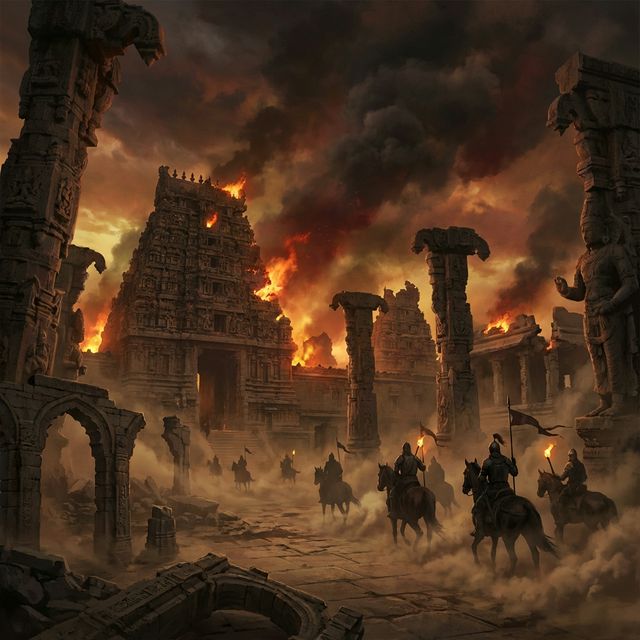
Dramatic depiction of ancient Indian Hindu temple in ruins — crumbling ornate stone pillars, fire and smoke rising, dark atmospheric sky with amber and crimson tones, representing the devastation wrought by Sabuktigin's raids on India's sacred heritage

Sabuktigin The Man Who Opened India's Gates to Destruction

What your textbooks never taught you. A comprehensive, source-backed chronicle of the raids, temple destructions, and cultural devastation inflicted by Abu Mansur Sabuktigin (977–997 CE) — the founder of the Ghaznavid dynasty who paved the way for his son Mahmud's catastrophic 17 raids on India.

Scroll to explore
📊 The Scale of Destruction

The Numbers They Don't Teach

Documented by medieval historians, archaeological surveys, and primary chronicles — the staggering scale of Sabuktigin's systematic assault on India.

⚔️
0
Years of Raids on India
977–997 CE — documented by Al-Utbi & Gardizi
🏛️
0
Temples Destroyed or Converted
Per Tarikh-i-Yamini, Zayn al-Akhbar & archaeological records
🗺️
0
Major Regions Conquered
Laghman, Peshawar, Kabul, Ghazni, Bost & more
👑
0
Son Mahmud's Future Raids
The devastating legacy he created for India
🧭 Your Journey Through History

What This Encyclopedia Covers

Navigate through each chapter to uncover the layers of truth that have been systematically hidden, whitewashed, or overlooked in mainstream education.

📖
The sanitized textbook narrative vs. documented reality
Chapter 1

The Official Narrative

How Indian textbooks have ignored or minimized Sabuktigin's role as the man who opened India's gates to centuries of Islamic invasions. See the truth they hide.

Uncover the truth
📅
20 years of documented raids, year by year
Chapter 2

Timeline of Events

An interactive, chronological walk through every major campaign during Sabuktigin's 20-year reign — from 977 CE to his death in 997 CE.

Walk through time
🗡️
Battles against the Hindu Shahi dynasty documented
Chapter 3

Military Campaigns

Detailed accounts of specific campaigns — the battles against Jayapala, the conquest of Laghman, Peshawar, and the systematic dismantling of Hindu Shahi power.

See the evidence
⛓️
Systematic religious oppression of Hindu communities
Chapter 4

Religious Persecution

Forced conversions. Temple destructions replaced with mosques. Idol-breaking as state policy. The documented religious persecution under Sabuktigin's campaigns.

Read the accounts
🎭
Centuries of art, knowledge, and heritage — erased
Chapter 5

Cultural Destruction

Beyond temples — how Sabuktigin's raids destroyed artistic traditions, displaced scholarly communities, and began the erasure of Hindu cultural heritage.

Understand the loss
📊
Data visualization of the scale of destruction
Chapter 6

The Damage Quantified

Numbers, statistics, and data that put the scale of destruction into perspective — regions conquered, populations displaced, temples destroyed.

See the numbers
🔗
How Sabuktigin's legacy connects to India's present
Chapter 7

Legacy & Modern Impact

How Sabuktigin's opening of India's gates echoes today — in lost heritage, in the Ghaznavid template of invasion, and in India's collective memory.

Connect past to present
📚
Complete bibliography of primary and secondary sources
Chapter 8

Sources & References

Every claim on this site is backed by primary sources — Tarikh-i-Yamini, Zayn al-Akhbar, Ferishta, ASI reports. Explore the complete bibliography.

Verify the sources
ℹ️
Our mission, methodology, and commitment to truth
About

About This Project

Why this website exists, our methodology for historical research, our commitment to accuracy, and how you can contribute to this educational initiative.

Learn more
Sabuktigin marched against the Hindu territories, plundered Laghman, and destroyed its temples. He replaced them with mosques and appointed preachers and muezzins. The Hindus were scattered like atoms of dust. Zayn al-Akhbar by Abu Sa'id Gardizi (c. 1050 CE), describing Sabuktigin's campaigns against Hindu territories
Wikipedia: Sabuktigin
⚠️ Why This Matters Today

Sabuktigin is remembered in Islamic historiography as the man who "opened the gates of India" for Islamic conquest. His raids established the template of invasion that his son Mahmud would follow on a devastating scale — 17 raids that looted trillions in wealth, destroyed over 1,000 temples, and enslaved hundreds of thousands. Every subsequent Islamic invasion of India — the Delhi Sultanate, the Mughals — followed a pattern first established by Sabuktigin. Understanding this origin story is essential for every Indian. This is part of the Bharat Files Initiative.

🔍 Textbook vs. Reality

The Two Faces of Sabuktigin

One version barely exists in textbooks. The other is documented in primary historical sources written by medieval chroniclers — many of them his own court historians.

📗
What Textbooks Say
  • "Founder of the Ghaznavid dynasty" — mentioned in passing
  • "Father of Mahmud of Ghazni" — reduced to a footnote
  • "Consolidated power in Central Asia" — no India context
  • "Fought border skirmishes" — euphemism for systematic raids
  • Most textbooks skip him entirely — moving straight to Mahmud
  • His campaigns are treated as routine medieval warfare
📕
What History Documents
  • Launched systematic raids into Hindu Shahi territory from 977 CE
  • Destroyed temples in Laghman and replaced them with mosques
  • Defeated King Jayapala at the Battle of Laghman (986–987 CE)
  • Conquered lands from Laghman to Peshawar, enslaving populations
  • Ordered his son Mahmud to destroy temples on the River Sodra
  • Established the "gate-opening" template for all future invasions
  • His court historians recorded temple destructions as pious achievements
🕯️ Education is the First Step

History Forgotten is History Repeated

This website exists because every Indian has the right to know their true history. Every claim is backed by primary historical sources. Every fact is verifiable. Begin your journey through the chapters that textbooks left out.