Chapter 3
Military Campaigns
Documented accounts of each major campaign — the battles against the Hindu Shahi dynasty, the temple destructions, and the territories seized.
Documented accounts of each major campaign — the battles against the Hindu Shahi dynasty, the temple destructions, and the territories seized.
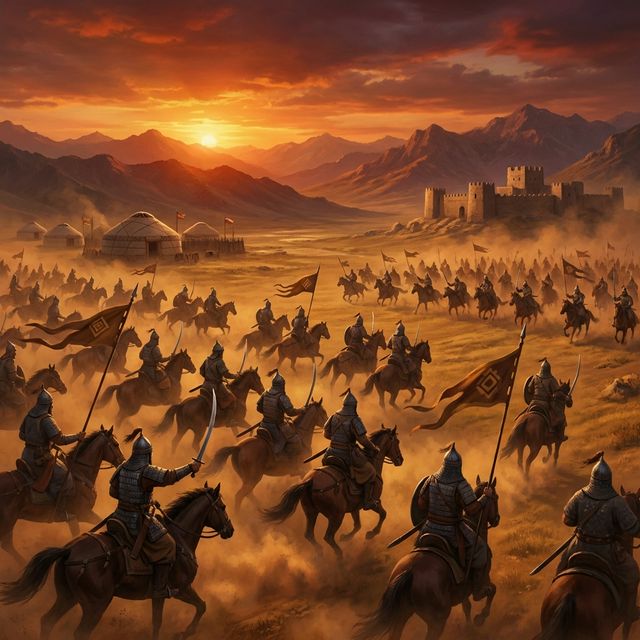
Sabuktigin's military campaigns against Hindu territories were not random border skirmishes. They were deliberate, strategically planned invasions designed to conquer Hindu Shahi territory, destroy Hindu religious infrastructure, and build a launchpad for further expansion into the Indian subcontinent. Each campaign is documented by medieval chroniclers.
Laghman (in modern-day eastern Afghanistan) was a prosperous center of Hindu and Buddhist civilization. It contained numerous temples, monasteries, and religious institutions that had thrived for centuries under Hindu Shahi protection.
According to Gardizi's Zayn al-Akhbar, Sabuktigin launched a devastating raid on Laghman:
This was not an isolated act of destruction. It was a deliberate policy of religious replacement — a template that would be followed by Mahmud of Ghazni, the Delhi Sultanate, and the Mughals for centuries to come.
The Battle of Laghman was the defining confrontation between Sabuktigin and the Hindu Shahi kingdom. It represents the moment when the balance of power in the region shifted permanently.
King Jayapala (r. c. 964–1001 CE) of the Hindu Shahi dynasty was one of the most powerful rulers in the region. Alarmed by Sabuktigin's systematic raids into his frontier territories, Jayapala assembled a massive coalition army. According to Ferishta, this army included forces from multiple Hindu kingdoms, united against the Ghaznavid threat.
The two armies clashed at Laghman. Multiple chroniclers record that a sudden, devastating snowstorm struck during the battle, crippling Jayapala's forces — who were less prepared for extreme mountain weather than Sabuktigin's Central Asian troops. The storm caused massive casualties and logistical collapse in Jayapala's army.
Jayapala was forced to sue for peace. The terms were humiliating:
However, when Jayapala returned to his capital, he reneged on the treaty — refusing to pay the agreed tribute. This gave Sabuktigin the justification for an even more devastating campaign.
When Jayapala broke the peace treaty, Sabuktigin launched his most ambitious campaign yet. According to Al-Utbi's Tarikh-i-Yamini, Sabuktigin conquered all territories between Laghman and Peshawar — a vast swathe of the Hindu Shahi frontier.
This campaign didn't just conquer territory — it eliminated the buffer zone that had protected the Indian heartland from Central Asian invasion for centuries. Sabuktigin now controlled the Khyber Pass approaches, giving his successors — principally his son Mahmud — direct access to the wealthy plains of Punjab and beyond.
One of the most revealing episodes in Sabuktigin's career is his direct role in training his son Mahmud as a temple destroyer.
According to historical accounts cited by multiple researchers (including Al-Utbi), Sabuktigin ordered his young son Mahmud to destroy a Hindu temple on the banks of the River Sodra (Chenab) — even before Mahmud had become sultan. This was not a spontaneous act; it was a deliberate training exercise in the practice of religious destruction.
Beyond the major campaigns against Hindu Shahi, Sabuktigin conquered several other regions that would become critical to the Ghaznavid Empire's power:
Strategic fortress city conquered early in Sabuktigin's reign. Became a major Ghaznavid military base.
Conquered to secure the southern approaches and trade routes connecting to the Indian Ocean.
Home of the famous Buddhas of Bamyan. Conquering this region gave Sabuktigin control over key mountain passes.
Rich agricultural lands that provided revenue and manpower for further military expansion.
Mountainous region whose conquest secured the western flank and eliminated a potential rival power center.
Sabuktigin's campaigns were not mere territorial expansion. They represented a strategic transformation of the region that had profound consequences for India: